Self-Supervised Localisation between Range Sensors and Overhead Imagery
Super Short Description
- Paper Link
- The goal is to pixelwise align image generated from live range sensor (radar/lidar) data with the overhead satellite image. Rotation angle and translation offset in x and y direction are the target to be predicted. Following previous work, the paper finds the rotation angle first and then finds the x,y translations. Key contribution is the unsupervised methodology for both angle and translation estimation.
Summary of Paper’s Methodology
As mentioned in the description above, the goal here to predict the rotation angle \theta and the translation vector \alpha which, when applied on the range sensor generated image, would align it with the given satellite image. Here, we will call range sensor generated image as modality B and satellite image as modality A
Estimating \theta
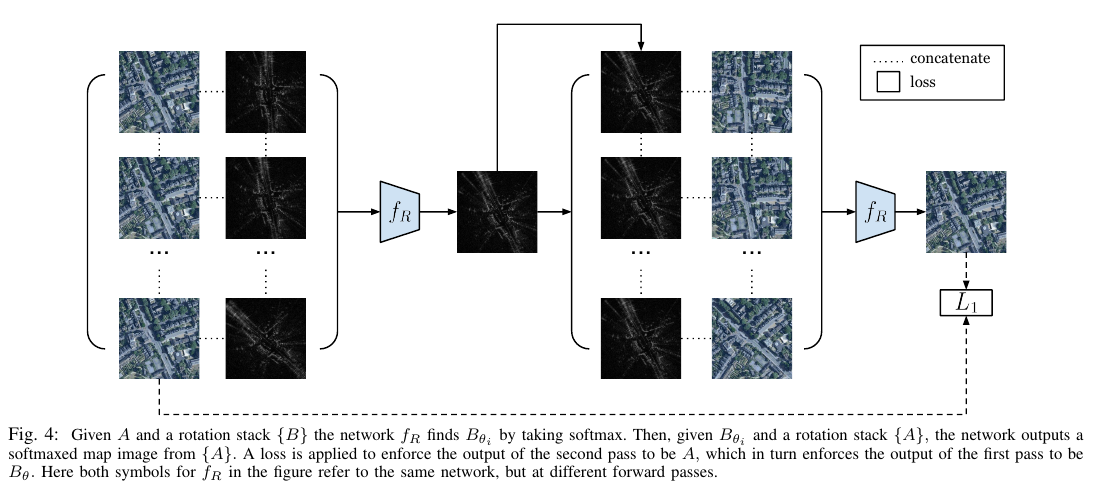
They build on a previous work. There, a deep network f_R was used. Let I_A and I_B denote the image of modality A and B respectively. A number of rotated versions of I_B were made. Each version was then concatenated with I_A. All this was given input to the network. The network generated a weighted average of rotated I_B images with largest weight being expected to be given to the correctly rotated version.
Note that in this paper, they don’t know the correct rotation angle. They came up with a method involving two passes through the network f_R. First pass is identical to what is mentioned above. Lets call the output of first pass as I_{B\theta}. For the second pass, they make several rotated versions of the I_A instead and club it together with I_{B\theta}. This$ time, they predict weighted average of rotated I_A images. Target for the output of the second pass is made to be I_A. This makes sense intuitively. If f_R is trained correctly, then for I_{B\theta}, A is the aligned satellite image. It can be inferred as I_{B\theta} is the output of the first pass. Therefore I_A should be predicted in the second pass.
Estimating \alpha: PASED Module
For this task, input is I_A and I_{B\theta} generated from the previous module. These two images are rotationally aligned and only the translation offset needs to be found.
For doing that, they needed following modules: 1. E_a: Encoder network to encode the appearance and content of I_{B\theta} 2. E_p: Encoder network to encode the pose (\alpha) between two translationally variants of I_{B\theta} 3. D: Decoder network which generates an image of modality B by taking appearance and pose latent vectors as input. 4. E_p^*: Encoder network to encode the pose (\alpha) between I_{B\theta} and I_A
They train it in two phases. In the first phase, they train E_a,E_p and D. > For training E_a,E_p and D, they capture pose from a pair of translationally differing images and apply the inferred pose on another image.
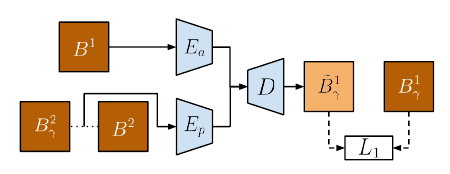
Let B^1,B^2 be images from the domain B\theta. They randomly pick a translation offset \gamma. They get the appearance of B^1 as E_a(B^1). They get the embedding for \gamma as E_p(B^2,B^2_{\gamma}). Here, B^2_{\gamma} is the translated version of B^2. Feeding above two appearance and pose embeddings in D, they train it end to end to get B^1_{\gamma}.
They use the trained E_a,E_p and D to train E_p^* in the second step. > For training E_p^* in an unsupervised fashion, which is equivalent to estimating the translational offset \alpha across different modalities,they utilize the additive property of the translation: Composition of two translations is equivalent in effect to a single translation with \alpha being the vector addition of the previous two {\alpha}s.